
Scientific Models of Collective Intelligence
Highlights include:
Ontology of collective intelligence
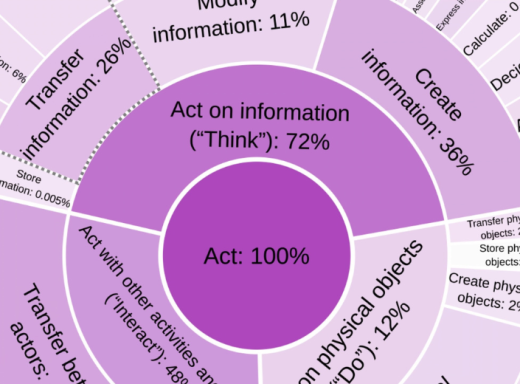
This project seeks to organize different types of tasks into “family trees” of increasingly specialized task types. This has the potential to provide a great economy of effort by automatically predicting which properties are similar for tasks in the same family, such as AI applicability or the suitability of potential alternative process designs. As a major step toward applying this approach, we have completed systematically classifying 20,000+ tasks performed in the U.S. economy from the U.S. Department of Labor’s O*NET database and have also used this framework to create a compelling graphical display of where AI is being used today. In coming years, we expect to use this ontology to create software applications that can help predict where AI will be used, foretell changes in skills needed in AI-enabled workplaces, and design novel work processes that take advantage of AI.
This project draws on prior research on business process design as well as current work on Supermind Ideator and the Supermind Design methodology.
Selected resources
- Alice Cai, Iman YeckehZaare, Shuo Sun, Vasiliki Charisi, Xinru Wang, Aiman Imran, Robert Laubacher, Alok Prakash, Thomas W. Malone, Where can AI be used? Insights from a deep ontology of work activities, CCI working paper, arXiv, Mar 2026.
- Malone, T. W., Crowston, K. G., & Herman, G. (Eds.) Organizing Business Knowledge: The MIT Process Handbook. Cambridge, MA: MIT Press, 2003.
- Malone, T. W., Crowston, K. G., Lee, J., Pentland, B., Dellarocas, C., Wyner, G., Quimby, J., Osborn, C. S., Bernstein, A., Herman, G., Klein, M., & O’Donnell, E. (1999). Tools for inventing organizations: Toward a handbook of organizational processes. Management Science, March 1999.
A multi-dimensional design space for group processes
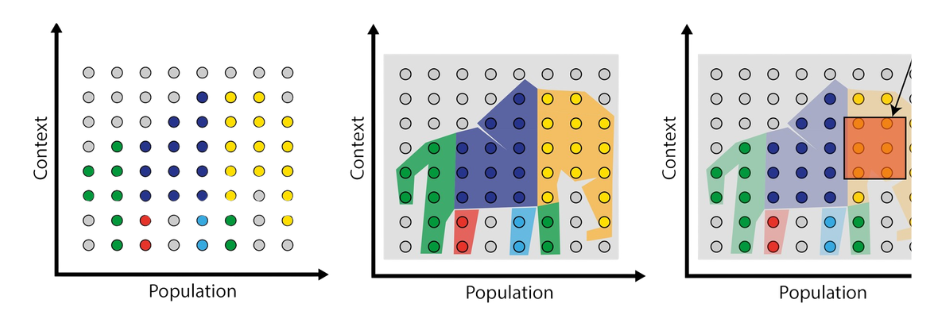
This framework uses techniques from AI to guide the design and analysis of large suites of experiments based on multi-dimensional characterizations of different tasks. This helps, for example, to integrate ostensibly “contradictory” findings from prior studies, identify contingencies for theories, and efficiently sample tasks for future experiments.
Selected resources
- Mohammed Alsobay, David Rand, Duncan Watts, and Abdullah Almaatouq. Integrative experiments identify how punishment affects welfare in public goods games. Science, Apr 2026.
- Xinlan Emily Hu, Linnea Gandhi, Mark E Whiting, Duncan J Watts, Abdullah Almaatouq. The Task Space: An Integrative Framework for Team Research. Management Science, Mar 2026.
- Mohammed Alsobay, David G Rand, Duncan J Watts, Abdullah Almaatouq. Integrative experiments identify how punishment impacts welfare in public goods games. arXiv Preprint 2025.
- Abdullah Almaatouq, Thomas L Griffiths, Jordan W Suchow, Mark E Whiting, James Evans, Duncan J Watts. Beyond playing 20 questions with nature: Integrative experiment design in the social and behavioral sciences. Behavioral and Brain Sciences, Dec 2022.
Mathematical models of group processes
Selected resources
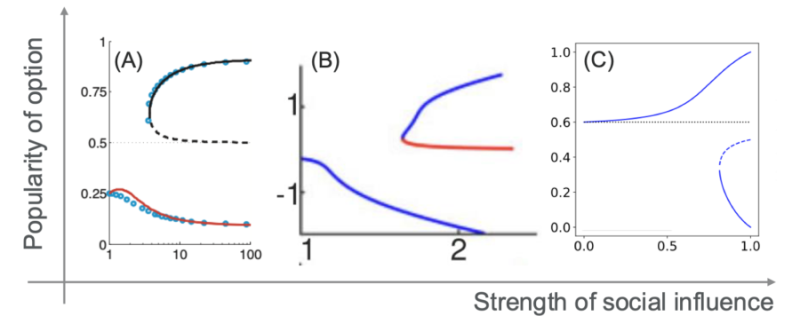
- VC Yang and L Grenier, (2024). How Social Influence Shapes Collective Intelligence in Binary Choices: Reconciling Disparate Findings with a Mathematical Model, SSRN, 2026.
- VC Yang and L Grenier. What Leads to Administrative Bloat? A Dynamic Model of Administrative Cost and Waste, arXiv, 2026.
- VC Yang, CP Kempes, S Redner, GB West, and H Youn (2024). Regulatory Functions from Cells to Society, arXiv, 2025.
- J Yoon, VC Yang, C Kempes, S Lee, G West, & H Youn. What makes Individual I’s a Collective We; Coordination mechanisms & costs. arXiv, 2024.
- VC Yang, and A Sandberg,. Collective Intelligence as Infrastructure for Reducing Broad Global Catastrophic Risks. Proceedings of the Stanford Existential Risks Conference, 2023 .