Designing collectively Intelligent systems
Includes design of Human-AI systems and Superminds
Highlights of this work include:
- Skills mapping for the age of AI
- Supermind Design, a methodology for designing collectively intelligent systems
- Supermind Ideator, a web platform that combines human creativity and generative AI to suggest possible solutions for a very wide range of problems input by users
- DesignAID, an application that relies on generative AI to assist in creating visual designs
Skills mapping for the age of AI
In collaboration with a major MIT Media Lab project, PATH (Pathways for AI Training and Hiring). CCI is mapping the skills that will be needed in an AI-enabled future. CCI’s work will be used by other members of the PATH team to develop educational offerings that can allow workers to obtain those skills.
Selected resources
Supermind Design

We use the term “superminds” as a shorthand for “collectively intelligent systems.” This work is based on concepts from Thomas W. Malone’s book, Superminds (Little Brown, 2019). The Supermind Design methodology features a set of questions people can ask themselves, individually or in groups, to trigger new ideas about how to develop superminds, including organizations, societies, teams, and human-computer combinations. Key concepts employed in Supermind design here are also used in the Ideator system (described below)
Selected resources
- Supermind Design page
- MIT Center for Collective Intelligence, Supermind Design Primer
- Robert Laubacher, Annalynn Bachmann, Kathleen Kennedy, and Thomas W. Malone. Supermind Design for inventing smarter organizations: Applying a new organizational design approach in a professional services setting. MIT Sloan Working Paper, 2023.
- Robert Laubacher, Gianni Giacomelli, Kathleen Kennedy, David Sun Kong, Annalyn Bachmann, Katharina Kramer, Paul Schlag, and Thomas W. Malone. 2020. Using a supermind to design a supermind: A case study of university researchers and corporate executives co-designing an innovative healthcare concept. MIT Sloan Working Paper, June 2020.
Supermind Ideator

Previous efforts to support creative problem-solving have included techniques (such as brainstorming and design thinking) to stimulate creative ideas, and software tools to record and share these ideas. Now, generative AI technologies can suggest new ideas that might never have occurred to the users, and users can then select from these ideas or use them to stimulate even more ideas.
Supermind Ideator was created to supercharge creative ideation by harnessing these new generative capabilities. The system uses a large language model and adds prompting, fine tuning, and a user interface specifically designed to help people use creative problem-solving techniques. Some of these techniques can be applied to any problem; others are specifically intended to help generate innovative ideas about how to design groups of people and/or computers (“superminds”).
Selected resources
- Supermind Ideator system
- Jennifer L Heyman, Steven R Rick, Gianni Giacomelli, Haoran Wen, Robert Laubacher, Nancy Taubenslag, Max Knicker, Younes Jeddi, Pranav Ragupathy, Jared Curhan, and Thomas W Malone. (2024) Supermind Ideator: How Scaffolding Human-AI Collaboration Can Increase Creativity, Collective Intelligence, 2024.
DesignAID
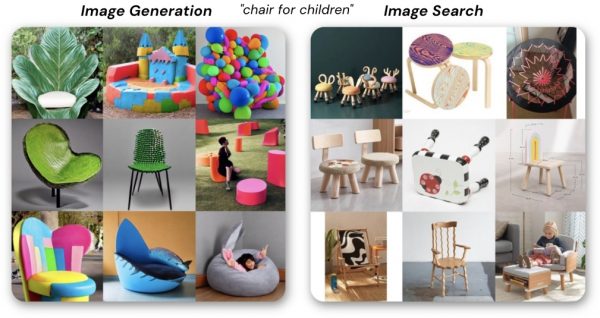
Designers often struggle to sufficiently explore large design spaces, which can lead to design fixation and suboptimal outcomes. We designed DesignAID, a generative AI tool that supports broader design space exploration, in order to help address this problem.
By using large language models to produce a range of diverse ideas expressed in words, and then using image generation software to create images from these words, we create human-computer teams that can rapidly create a diverse set of visual concepts without time-consuming drawing.
Selected resources
- MIT Sloan School of Management, A generative AI tool to inspire creative workers, Feb, 2024.
- Cai, A., Rick, S. R., Heyman, J., Zhang, Y., Filipowicz, A., Kong, M., Klenk, M., Malone, T. (2023). DesignAID: Using generative AI and semantic diversity for design inspiration, ACM Collective Intelligence Conference, 2023. Winner of Conference Best Paper Award.
Who2chat/Togedule

- Park, S., Song, J., Karger, D. R., & Malone, T. W. (2024). Who2chat: A Social Networking System for Academic Researchers in Virtual Social Hours Enabling Coordinating, Overcoming Barriers and Social Signaling. Proceedings of the ACM on Human-Computer Interaction, CSCW, April 2024).
- Song, J., Ashktorab, Z., & Malone, T. W. (2025). Togedule: Scheduling Meetings with Large Language Models and Adaptive Representations of Group Availability. Proceedings of the ACM on Human-Computer Interaction, CSCW ’25, October 18–22, 2025, Bergen, Norway
Designs for other collectively intelligent systems
- Esvelt, Kevin. Don’t Wait for the Crisis: How Markets Can Fund National Resilience. American Affairs, Fall 2026.
- Song, J., Ashktorab, Z., Pan, Q., Dugan, C., Geyer, W., & Malone, T. W. (2025). Interaction Configurations and Prompt Guidance in Conversational AI for Question Answering in Human-AI Teams. Proceedings of the ACM on Human-Computer Interaction, CSCW, Oct 2025.